This week in science I dissected a skate. Which is closely related to a shark but looks like a ray fish. I also learned the anatomy of the skate before we actually dissected the skate. At first it was difficult to cut the skate because of its cartilage instead of bone. So we took a scissor to cut an incision down the middle of the ventral side. When we finished that we saw the liver, intestine, and stomach.
What I learned is that a skate doesn't have bones it has cartilage. Cartilage is firm, flexible tissue found in the internal ear, nose, elbow, knee etc. But it is still very difficult to cut because of this. I learned that the hard way hen trying to make an incision in the skate's chest. What I also learned was that the skate's brain is at the side of the skate's head.
The two organisms that were dissected were the frog and skate. The brain, eyes and skin were a few examples of functions that work the same but appear different. One similarity for the brain, eyes, and skin of the frog and skate is that each allow its host to adapt to its environment effortlessly. Allowing them to think quickly, see predators, and evade predators using camouflage. A difference for the brain, eyes, and skin are that the skate is able to make quick last minute decisions, its eyes are able to adapt to the dark parts of the ocean. While its skin allows it swim with little effort. The frog's brain although small comes in use. While the eyes allow the frog to see thing behind it. Also its skin in covered in mucus to that it appears slippery to predators.
Thursday, February 16, 2012

Friday, February 3, 2012
This Week In Science #8


Monday, January 23, 2012
This Month in Science
What I did this month in science is create a slide show video. The slide show video talked about a biome of your choice and describe the animals that live there the vegetation and the location of many different arctic tundras around the globe. The project was a lot of fun and very informational on stuff that I didn't know before. Working with my group was also fun and I enjoyed working with them. This project was very educational and taught me a lot of things about arctic tundras and what they consist of.
What I learned this month in science is how to work with other people and how to make a video with a group. I learned about many other organisms that lived in arctic tundras, and I thought there wouldn't be as many as there are in a rain forest but there seems to be a lot of animals living in the arctic. A couple that my group chose were harlequins ducks, snow hares, arctic seal, and polar bears. Learning that many different diverse animals also can be found in the arctic was very informational. I hope to do more projects like this
Thursday, December 22, 2011
Crickets Investigation
Cricket Background Research: Crickets have some type of relation to grasshoppers. They come from the genus Orthoptera, this genus consists of crickets, grasshoppers, and locusts. The cricket consumes anything from meat to plants. At times they even consume each other. They live under rocks and logs in meadows, and they are also nocturnal. They only come out at night to hunt and feed. They are prey to spiders, wasps, beetles, birds, rodents, and lizards. In order for them to mate the male cricket rubs their forewings to attract their mates. While the female crickets lay eggs in the soil. The crickets also play an important factor in the ecosystem. They help breakdown plant material, renewing soil minerals. A negative impact they have on the ecosystem is that they injure seedlings, and male cricket songs can be loud and obnoxious.
Question: Which food choice will the crickets prefer?
Hypothesis: If we give the crickets a choice of apples and celery then they will eat the apples because based on other observations they prefer apples.
Digital Picture:
Data Table:

Explanation: what I did was at first we placed both options (the celery and apples) into the container. After I put the crickets (two) into the container along with the choices. After, my partner and I recorded what we saw so far between the crickets and their new environment we also came to the conclusion that both crickets liked both options.
Conclusion: When two crickets were placed into the container with both options of celery or apples, at first both crickets were fond of the apple option. But when the other option (the celery) was placed closer to them they began to take a liking to both the celery and apples. The evidence that supports this is that one cricket at first only preferred the apples, but when another cricket was placed with it they both seemed to like both of the options.
Question: Which food choice will the crickets prefer?
Hypothesis: If we give the crickets a choice of apples and celery then they will eat the apples because based on other observations they prefer apples.
Digital Picture:
 | |||||||
| Crickets in container with celery and apples |
Data Table:

Explanation: what I did was at first we placed both options (the celery and apples) into the container. After I put the crickets (two) into the container along with the choices. After, my partner and I recorded what we saw so far between the crickets and their new environment we also came to the conclusion that both crickets liked both options.
Conclusion: When two crickets were placed into the container with both options of celery or apples, at first both crickets were fond of the apple option. But when the other option (the celery) was placed closer to them they began to take a liking to both the celery and apples. The evidence that supports this is that one cricket at first only preferred the apples, but when another cricket was placed with it they both seemed to like both of the options.
Monday, December 19, 2011
classification challenge
Genus: pisaster(pacific sea stars)
species: brevispinus(fast growing0
summary: My starfish can be found in sand or mud when catching its prey. They may also be found on rocks ao pillars when searching for prey such as barnacles and tubeworms. It doesn't tolerate being out of water very well. the only time that a pink sea star may be seen out of the water is during low tides. It usually lives in the water at depths of 600 feet. It is able to regenerate as long as it still has its central disk. The Pink starfish also has eyespots on each of its arms to see in each direction to be aware of predators. The Pink starfishes predators consist of sharks, manta rays, and large bony fish.
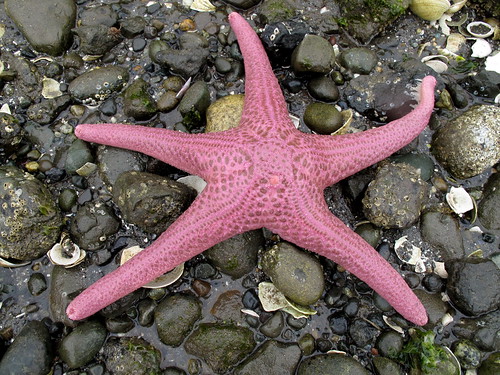 |
| Pink Starfish |
Kingdom: Animalia(from the animal kingdom)
Phylum: Echinodermata(marine invertebrates)
Class: asteroidea(meaning sea stars)
Order: forcipulatida(order of starfish)
Family: asteriidae(animal life)Genus: pisaster(pacific sea stars)
species: brevispinus(fast growing0
summary: My starfish can be found in sand or mud when catching its prey. They may also be found on rocks ao pillars when searching for prey such as barnacles and tubeworms. It doesn't tolerate being out of water very well. the only time that a pink sea star may be seen out of the water is during low tides. It usually lives in the water at depths of 600 feet. It is able to regenerate as long as it still has its central disk. The Pink starfish also has eyespots on each of its arms to see in each direction to be aware of predators. The Pink starfishes predators consist of sharks, manta rays, and large bony fish.
Friday, December 9, 2011
This week in science #6
This week in science we continued our investigation based on cricket's behaviors. But we took it even farther when we made questions based on whether they would prefer a wet or dry environment. After that we recorded our observations using method 1. This method allowed us to view the crickets in a way that was clear and understanding. Wherever the crickets traveled in the bin whether it was in the wet region or dry region we made a dot to represent which environment they preferred. Later in the week we used another method to classify jellybeans called the dichotomous key method. It was an exciting project but at times became frustrating.
This week in science I learned about other ways to observe and record my findings about animal behaviors. I also learned a method to classify animal characteristics in the future in which it will be needed in the future.
This week in science I learned about other ways to observe and record my findings about animal behaviors. I also learned a method to classify animal characteristics in the future in which it will be needed in the future.
 |
| jellybeans |
Friday, December 2, 2011
This week in science #5
This week in science we continued put the final touches onto the rocket investigation. We launched them to see if what we came up with would answer our questions. For example my question was "Will the weight of the nose cone affect the rockets distance?" After launching the rockets we found our answer. The weight of the rocket's nose cone does in fact affect the rocket's distance. Later in the week we began our unit about animals. We looked at animal behavior, and partically crickets. I found it fun because we got a chance to look at funny animal videos in order to evaluate their behavior.
This week in science I learned about animal behavior. We learned only a little of this because we just started yesterday, but enough for me to like it already. We also watched funny animal behavioral videos that made taught us things, but also made us laugh. I think that we should do more lessons this way. This week in science was a good week.
This week in science I learned about animal behavior. We learned only a little of this because we just started yesterday, but enough for me to like it already. We also watched funny animal behavioral videos that made taught us things, but also made us laugh. I think that we should do more lessons this way. This week in science was a good week.
Subscribe to:
Posts (Atom)